Today I filled in a reference for a former student who wishes to undertake a course at Judge Business School, University of Cambridge. The experience was so bad, so bad, that it inspired me to write this blog post.
Let's remember the setup. I'm not being paid to write this reference. I'm doing it as a favour to my former student, and as a favour to my academic colleagues at the University of Cambridge. I'm happy to do it to help both sides. But - and it's appropriate to repeat this when it is after all a business school I am talking about - I'm not being paid for this task.
Also let's straight away take the student off the hook. They want to do a course at this famous Business School, so they have no choice but to ask me to supply a reference according to the demands of Cambridge University.
You might think in these circumstances - doing unpaid work for their direct benefit - the University of Cambridge might make my life as easy as is reasonably possible.
Instead they use some online reference software provided by - I won't name them because they don't deserve an extra hit on Google Search. Though now I think about it, the name of the firm is appropriate as it reminds me of Hobson's Choice, an unpleasant choice where no alternative is offered.
Here are some of the highlights of my experience. Ignoring of the course it being ridiculous to have to use special purpose software in the first place - Cambridge should give me multiple options to make my life easier. But let's pass that by quickly.
First piece of joy. I was sent in plain text a username and password. (Yep, password in plain text because nobody at Cambridge is a world expert on security).
Well, actually that's pretty standard, it washes by me. But first thing I had to do was ... be forced to change my password! For what is to all intents and purposes a one-time logon: it would be a miracle if this login was used the next time they ask me to write a reference. As usual, non security enhancing requirements were made. So yeah, they wasted my time making me choose a password I will never use after they sent me an initial password by email.
Another thing I particularly liked was being asked to provide a phone number with numbers only. Guys, phone numbers sometimes require non numbers, especially the + for country code. And people like to write spaces and brackets while computers are good at stripping them out. But the better one was being told the date format for today was incorrectly entered: I think I left out the initial 0 on the date. It would of course be hard to automatically enter today's date for me.
Apart from starting to mentally write this blog post at this point, I actually got to the bit where I could start to enter my opinions. Which was not too bad except that ... after being forced to use this web form I was not allowed a text box to enter my comments in. I had to upload my comments in a document. Umm, why no choice to type it or paste it? I was asked to do it on headed notepaper, because umm, actually I can't think of a reason. Headed notepaper used to be a very slight fraud deterrent, indicating the letter was from somebody with access to it. Nowadays of course, it's a mild pain for academics at a University to provide an electronic document on headed paper (the clue is in the name, paper, this is an electronic document guys!) and of course no problem at all for somebody who intercepted the email to forge if they wish.
All of this shameful non-usability, inconvenience, and complete lack of consideration to the person who is paying with their time and effort, is sadly par for the course in writing references these days. I probably wouldn't have bothered with this post except for one last vignette.
At one point I was told that my comments were confidential and would not be disclosed to the candidate. So apparently Judge Business School (or their online reference providers) have some magic exemption to the data protection act? The irony is, that according to my University, I cannot be forced to provide this reference, but Cambridge might be. Actually I always assume that references might be shown to the student, and would never write something that fundamentally could not be (even if what I write may not always be what they want to read.) But a blanket statement which essentially ignores the Data Protection Act - and remember provided by a company who is providing a service so are assumed to be experts?
I titled this post by stating that whatever these choice people are paying the University of Cambridge for the right to upset their referees and thereby disadvantage both the University and their potential students, it's not enough. I take that back. If it's several million a year then that's enough to pay me £1000 or so for the benefit of my reference and my later thoughts of this blog post. You've got my address in your reference system.
best wishes
Ian Gent
Tuesday, 4 December 2012


Monday, 15 October 2012
Understanding the Nobel Prize
It's not often - maybe never before now - that I've understood technical aspects of the work behind a Nobel Prize.
But today I found out that Shapley has shared the Nobel Prize in Economics with Al Roth. Sadly Gale has died so cannot be awarded the prize.
The crux of the work is the Gale-Shapley algorithm on "stable marriages." So yes, deep down the Nobel prize has been awarded for an algorithm.
The idea of a stable marriage is when men want women and women want men, but we don't want marriages which will break up. A marriage will break up if there is an "unstable pair", two people who would rather be with each other than their spouses. It's all theoretical - it doesn't assume same-sex marriages, polygamous ones, or romantic preferences that change with time. But it leads to a lovely algorithm, and interesting insights. It's really interesting stuff and lovely. I've written some papers on it from the point of view of constraint programming, my research area.
11 years ago I co-wrote a paper on this topic for the big conference in Constraints. It was a privilege to work with Rob Irving and David Manlove. And I don't think that Barbara or David or me will mind admitting that in that case the key authors of the paper were Rob and Patrick Prosser. The thing that interested me on the topic was that it turned out we could turn the efficient Gale-Shapley algorithm into an efficient constraints algorithm (in a certain technical sense, no need to go into that here.) But what was even better was that this technical efficiency turned out to be interesting in its own right, and analysis of it led to a big part of a PhD, specifically Martin Green's to be precise, Holloway, 2005. Not the only PhD in constraints and stable matching neither - here's to Chris Unsworth - but maybe the one that took our work in an unexpected direction.
However for practical purposes, our work in Constraints didn't really take off. We hoped it might, but it didn't. The real practical purpose of this work is kidney-matching. This is a huge ethical problem for which people quite rightly (in most people's view) don't think money is the right solution. The solution is a stable matching where everyone benefits. That's what part of this Nobel prize for, for Al Roth. And that is what David Manlove uses this work for - of course extending it as well for scientific interest, but also helping people get kidney transplants they wouldn't otherwise get.
So this is what a Nobel Prize means if you understand something about its technicalities. It turns out it has influenced people many decades later in other countries, and then their work influences other people in turn, in a research area some way off the original. And then people get new kidneys.
p.s. Yes I know it's not really the Nobel Prize, it's the Nobel Memorial Prize, but everybody calls it the Nobel Prize in Economics including the BBC and the Guardian.
But today I found out that Shapley has shared the Nobel Prize in Economics with Al Roth. Sadly Gale has died so cannot be awarded the prize.
The crux of the work is the Gale-Shapley algorithm on "stable marriages." So yes, deep down the Nobel prize has been awarded for an algorithm.
The idea of a stable marriage is when men want women and women want men, but we don't want marriages which will break up. A marriage will break up if there is an "unstable pair", two people who would rather be with each other than their spouses. It's all theoretical - it doesn't assume same-sex marriages, polygamous ones, or romantic preferences that change with time. But it leads to a lovely algorithm, and interesting insights. It's really interesting stuff and lovely. I've written some papers on it from the point of view of constraint programming, my research area.
However for practical purposes, our work in Constraints didn't really take off. We hoped it might, but it didn't. The real practical purpose of this work is kidney-matching. This is a huge ethical problem for which people quite rightly (in most people's view) don't think money is the right solution. The solution is a stable matching where everyone benefits. That's what part of this Nobel prize for, for Al Roth. And that is what David Manlove uses this work for - of course extending it as well for scientific interest, but also helping people get kidney transplants they wouldn't otherwise get.
So this is what a Nobel Prize means if you understand something about its technicalities. It turns out it has influenced people many decades later in other countries, and then their work influences other people in turn, in a research area some way off the original. And then people get new kidneys.
p.s. Yes I know it's not really the Nobel Prize, it's the Nobel Memorial Prize, but everybody calls it the Nobel Prize in Economics including the BBC and the Guardian.
Tuesday, 7 August 2012

Tuesday, 14 February 2012
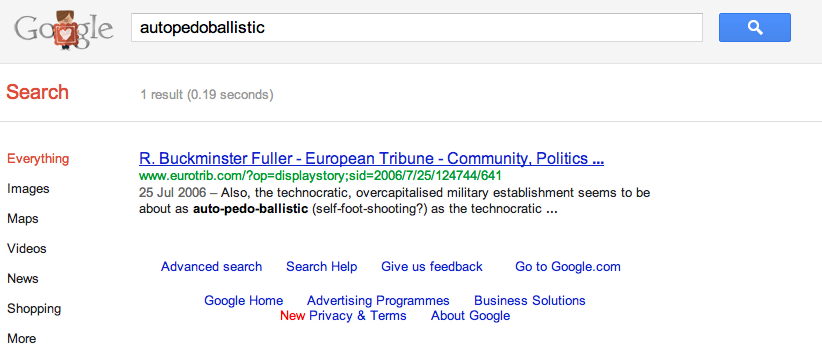
Shooting a googlewhackblatt in the foot
A googlewhackblatt is a single word query to Google that gets one hit. And one such word is autopedoballistic. Made up to mean shooting yourself in the foot. But since I have just posted this page, I am guilty of autopedoballistics by ruining it myself. So here's the proof.

Friday, 7 October 2011
Ada Lovelace day
Kind of sad that I didn't see Ada Lovelace day coming. I don't know if it needs better publicity, but I hope it's no reflection on a perceived lack of importance of women in computing. For sure we're not at a point where there's no need to enhance women's position in the discipline.
So a woman who influenced me in computing?
The more I thought about it the more obvious it became.
 Margaret Gent, of course. My mother. So apart from obvious motherly things, then here are some things about her which influenced me in computing.
She gave my dad his Curta calculator, roughly 1950 or so. He later gave it to me, and I still think it is the most beautiful object I own. Bearing in mind of course I don't own my wife or children.
A long time ago, she made a 4 bit adder out of components, a large piece of board, switches and solder. To illustrate how computers work for her students - she was a maths teacher. I don't know when it was done but the 1960s is a safe bet - I remember it when I was very young. It seemed almost magical to me. Brilliant.
She bought me - to be honest I don't know how much the split of decision making was with my father - my first programmable calculator, the wondrous TI-57. Not quite my first programming as that had been done on an HP 25 borrowed by my dad from work - or lent by Spencer Noble.
She got my name into print for computing for the first time by commissioning me to calculate a table for her book "Maths for Scientists". So yes, my first ever computing publication in any form was published by Mills & Boon!
Nothing to do with computing. But during World War II, as a radar technician at TRE Malvern, she once swapped cockpits in a Swordfish in mid air. A good idea to look at the picture, as you'll see this is not swapping seats in a jumbo, it's a lot more fun than that. More notably perhaps, to this day she denies it as being anything of note to have done it.
Maybe not so surprising that the first thing I did when I was promoted to Professor was to make sure my mother could come to the ceremony.
So a woman who influenced me in computing?
The more I thought about it the more obvious it became.

 |
| Curta Calculator, from Wikipedia |
She gave my dad his Curta calculator, roughly 1950 or so. He later gave it to me, and I still think it is the most beautiful object I own. Bearing in mind of course I don't own my wife or children.
A long time ago, she made a 4 bit adder out of components, a large piece of board, switches and solder. To illustrate how computers work for her students - she was a maths teacher. I don't know when it was done but the 1960s is a safe bet - I remember it when I was very young. It seemed almost magical to me. Brilliant.
 |
| TI-57 Calculator, from Wikipedia |

She bought me - to be honest I don't know how much the split of decision making was with my father - my first programmable calculator, the wondrous TI-57. Not quite my first programming as that had been done on an HP 25 borrowed by my dad from work - or lent by Spencer Noble.
She got my name into print for computing for the first time by commissioning me to calculate a table for her book "Maths for Scientists". So yes, my first ever computing publication in any form was published by Mills & Boon!
 |
| Fairey Swordfish, image from Wikipedia |

Maybe not so surprising that the first thing I did when I was promoted to Professor was to make sure my mother could come to the ceremony.
Friday, 12 November 2010
How to steal a laptop
Years ago my colleague (who we'll call Woolf T Flywheel) had his laptop stolen. How did it happen?
His laptop developed a fault, so he called up Compaq to get it repaired under warranty. (I told you it was years ago, they were later bought by HP.) They sent out DHL to take it back to their service centre.
A day or two later a nice chap from Compaq rang up to ask what the problem was with the laptop. Woolf told him, of course.
A few days later Woolf rang up Compaq to ask what had happened to his laptop. The reply was "What laptop? We never got it."
It had been stolen, the police came to the office. It more or less must have been an inside job at DHL. Somebody's insurers (probably DHL's) paid Woolf back, and laptop prices had fallen so much that the difference was enough for Woolf to buy a £600 fat boy lazy chair (or was it two?)
But what has always stuck in my mind was the brilliance of ringing up to ask what was wrong with the laptop. It did two things at once. First, it delayed for a few days Woolf ringing up to ask what had happened. And second, they could find out what was wrong with it so they could fix it before selling it!
Wednesday, 6 October 2010
Future Theatre Director
Just came back from the Shakespeare School's Festival. 4x 30 minute productions by various high schools. Outstanding production of The Tempest directed by one Alex Horan of Balwearie High School. Turns out she's 16! Director of the charity (who also commisioned the animated Shakespeare for S4C) says she wants to work as a director - she could make it.
Subscribe to:
Posts (Atom)