Tuesday, 27 August 2013

Scraps from a parallel universe: Alan Turing Obituary

Manchester Grauniad, 27 August 2013

Lord Turing of Bletchley died yesterday, 26 August 2013, Aged 101. 


It is appropriate that the great computer pioneer, Alan Turing, died at an age which looks like it is written in binary.  But it is also fortunate for his family, friends, and the world, that he lived for 96 years longer than that, since 101 in binary is 5.

Lord Turing achieved scientific fame based on his 1936 paper which introduced the concept of a "Turing Machine", leading to the theoretical basis of computer science.  During the war and afterwards he worked on the hardware aspects of computers, so can also be seen as a founder of practical computer science.  Not content with this, he founded Artificial Intelligence with his seminal paper "Computing Machinery and Intelligence."  It was for these contributions that he became, in 1965, the first winner of the Von Neumann award, the highest recognition for a Computer Scientist.

Turing's originality did not finish having founded Computer Science and Artificial Intelligence. He continued with productive and original work, both theoretical and practical, throughout the late 1950s, the 1960s and through most of the 1970s.  Indeed as Emeritus Professor in the 1980s he was a familiar sight cycling to his office to share a new result with his colleagues.  His most important contributions from this phase of his career can be summarised thus:

...

[Unfortunately here a page is missing from the scrap that traversed the parallel universe.]

... 

It was only in his later career that it became widely known that his work on wartime cryptography had been of major importance in helping to win the war for the Allies, and it was this which propelled him from simply being recognised by scientists as first among equals, to being a national hero.

Lord Turing married relatively late in life, having met his future husband in June 1954 at the age of 41.  Their marriage in 1955 was one of the first same-sex marriages in the UK, reflecting the country's recognition of the contribution to the war effort that gay people made.  His husband predeceased him in 1996.

When asked in old age about the secret of his long life, Lord Turing often joked that it was eating an apple every night in bed that kept him alive.    

The Grauniad contacted some of Turing's friends and colleagues for reactions to his passing.

Steve Jobs, Apple: "Whenever I thought of 'there's an app for that' I thought of Turing and his incredible foresight - before computers were invented - that a single machine could act as any other machine."

Sir Douglas Adams, Author: "Everyone knew Turing through his work, but knowing Turing as a friend was something special.  In fact, it was Alan who suggested that 46 would be the funniest number to be the answer to life, the universe, and everything."

John McCarthy, Artificial Intelligence pioneer: "Alan always saw the big picture as well as
the details, and indeed suggested the names 'first' and 'rest' for key operations in my programming language, instead of some arbitrary names I had in mind based on the machine I was working on at the time."


Friday, 28 June 2013

An Astonishingly Wonderful Thing

"I have written to the Governor General asking her to commission Rudd as Prime Minister of Australia." 
From Julia Gillard's resignation speech
I don't know anything about this situation, but ... 

... peaceful replacement of one leader by another is an astonishingly wonderful thing, and one of the great inventions of democracy. Or if not an invention then at least highly polished by democracy. 

Just since 1945 in the UK: Churchill, Attlee, Home, Wilson, Heath, Callaghan, Thatcher, Major, Brown. Whatever you think of these people, they all lost an election (Thatcher's a party one like Gillard) and handed over power to somebody else because that's the way democracy works.

There is PLENTY to complain about in democracies and the way politicians work. But sometimes let's pause and celebrate this fact. Let's not forget that engineering a peaceful takeover by his political opponents won F W De Klerk the Nobel Peace Prize.


Tuesday, 25 June 2013

Sky TV Nuisance Calls

Sky TV, stop the nuisance calls to my home!

This happened because I had the cheek to try to get out of a relationship with you.   Now you are making nuisance calls,  inquiring into my relationship with my wife, and then accused me of impersonating myself.   Then you refused to note in the account that we did not wish to receive any more phone calls from you.

When I said I was 100% confident that the account holder (my wife) would not wish to discuss this further with you, you refused to take my word for it.

At about that point you asked about my relationship with the account holder.  To be precise you said "Who are you to Ms Underwood?"

Yes, as a private company with a business relationship, you started asking me personal questions about my relationship with my wife.    (Ok you don't know she's my wife, I've now let that slip.  But it's still none of your business.)

When I said that my wife had empowered me to deal with you on this account, which is all you needed to know, you told me that you didn't know that.  I said you did, because you called our home address, which I knew, and I also knew the account password which you had asked for.

At this point you said that you didn't know who it was you were speaking to.

So yep, you asked about my relationship with my wife, then accused me (after passing all your security checks) of not being me.

All this because I told you I did not want to tell you why I want to stop getting Sky TV.

I will write it simply.

STOP MAKING NUISANCE CALLS TO MY HOME.

For others not in an abusive relationship with Sky, let me go back a few steps in the process so you can understand how this happened.

The other day we cancelled Sky TV.  This was an incredibly painful process, marred for example by the fact that the Sky website said we could cancel by email ...


... then when I finally gave in and phoned to cancel, I was told that not only was it impossible to cancel by email, but that I had to pay for the three days I had spent waiting to hear back.

Incidentally, this is still what the web page says as I write this (25 June 2013).  If the agent is right that cancellation by email is impossible, they are (at the very best) misleading customers by stating this.   I say at the very best, because in fact this results in more money being paid by customers to Sky.  One waits a few days to find out it's impossible - having given clear notice in writing that one wishes to cancel - Sky then tells you the method they themselves provided is invalid and you have to pay for those extra days.  If this is legal, there's something wrong with the law.

Anyway in the end we managed to cancel over the phone.  Not being happy campers, we did not see fit to give our reasons.  Well to be honest, we did say that we were not watching Sky at the minute, which is completely true.  But we kept being probed further - on what should have been a simple phone call.  I.e. the call should go:

Us: We wish to cancel.

Sky: Ooh, sorry to hear that, can we interest you in maybe an offer to keep you?

Us: No, thanks very much.

Sky: Oh well, ok, let me just tap these buttons... well thanks very much for your custom. Oh and sorry for the email thing, we'll backdate the cancellation three days.

But no.  Not only was there abject refusal to backdate the cancellation (I was told her manager couldn't do it and her manager's manager would not come to the phone), but my simple wish to cancel the account and get on with my life was not respected with incessant questions about what other service I was going to use etc.  It's not so much that I mind being asked these questions - they are obviously useful market research for Sky.  But I minded very much indeed when my polite refusal to answer them was not respected.  In the end the phone rep did give me two days money back - not three days because she said they would have had to call back the next day.  That doesn't seem reasonable to me but at that point I gave in.

Oh I haven't mentioned the bit where several times the rep told me things that were not true. E.g.  that I had been informed that cancellation by email would require a phone call and I was told it might take 72 hours to hear back from my email.   Neither is true.

Today I was at home and received several calls asking for my wife.  The last time I asked who it was to be told it was Sky TV.  I said I could speak for the account holder so the guy said it was about our cancellation and some extra details they needed.  The extra details were ... the reasons for cancelling Sky TV.  I told him I wasn't going to tell him, so he said he would call back for the account holder...

So I said that she would not want to give reasons either, and he said he would call back, and I asked him not to.   Which obviously is an unreasonable request, as he refused even to enter into their system that we did not wish to be called on this.

STOP MAKING NUISANCE CALLS TO MY HOME.

Obviously, Sky, if you have a genuine reason you need to call us (maybe the bank refusing to stop the direct debit or something), that's fine.   The fact that your system requires a reason for cancellation when we don't wish to give you one is NOT a good enough reason to call us.  Oh, and by the way, remember that we did give you a reason anyway?  In our email to you, and on the phone the first time, when we said we just weren't watching much Sky TV?

I am posting this online because I complained the other day about not hearing anything from my email request.   I was told I would hear back within 24 hours about my complaint.  So far I have heard nothing.  That was five days ago (three working days.)  

Obviously Sky TV ignores complaints using their online system.  So I have written this blog post.


Friday, 14 June 2013

Mansplaining the Mansplainer

This is a fantastic story my wife Judith Underwood told me many years ago, posted here with her permission.

Before I go on, let's just clear up the definition of mansplaining:
"The tendency of some men to mistakenly believe that they automatically know more about any given topic than does a woman and who, consequently, proceed to explain to her- correctly or not- things that she already knows."  Urban Dictionary
I was pointed to the "Mansplained" tumblr today by Mikael.  It's fantastic, though wear fire retardant clothes if you are a woman or have ever liked a woman.

By wife once scored a wonderful triumph by mansplaining to a mansplainer.  Here's the story.

When she did her degree in maths and computer science at Oberlin College in the late 80s, they had a computer lab full of terminals.  (In those days terminals would be "dumb terminals", probably a green on black screen with no fancy graphics, but I just mention that for nostalgia.)

One of the terminals in this particular lab had the habit that once in a while it would freeze up.   It would freeze for maybe 15 minutes.  The only fix was to not touch any keys.  Every time you touched a key, it would be frozen for 15 minutes. You had to walk away and use another terminal, and 15 minutes later it would come back to life. All the CS students knew this, but other occasional visitors would get caught.

One day Judith was in the lab and a man came in and started using this terminal.  It froze up.

The guy started expressing exasperation.  Judith told him he had to leave it for fifteen minutes. The guy started banging keys.  Judith told him he had to leave it for fifteen minutes. The guy started mansplaining to Judith that there were various things he could try.  Judith told him he had to leave it for fifteen minutes. The guy started banging various other keys.

Judith just said to him: "Just leave it for fifteen minutes, and don't worry your pretty little head about it."

She walked away and he looked dumbfounded.  He'd been mansplained.

I love my wife.

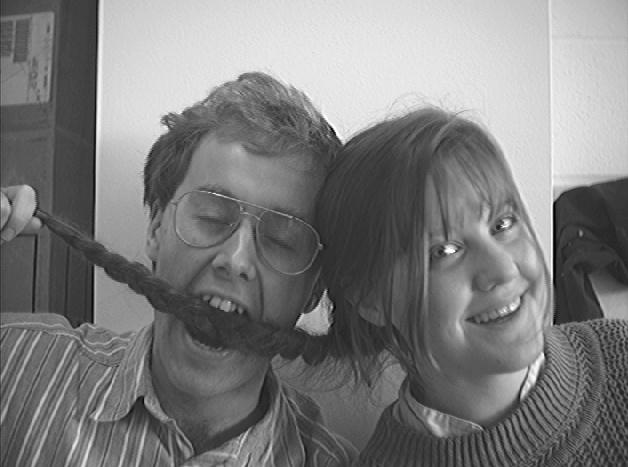
As a coda, purely for fun, here is a picture of me and my wife, a few years after this story happened but so long ago that a digital camera was super cool, in black and white only, and in research labs like at Cornell where she did her PhD.  She still has the same great hair, and I don't.


Monday, 3 June 2013

Dr Who, The Master, the Captain of the Starship Enterprise, and Uncle Claudius

Is this the most ridiculous coincidence involving the most famous science fiction TV characters ever?

In 2009's BBC Hamlet, Dr Who played Hamlet, while the Captain of the Starship Enterprise played his Uncle Claudius.

In 2007's Utopia, the same Dr Who faced off against the Master.

In 1980's BBC Hamlet, the same Master played Hamlet, while the same Captain of the Starship Enterprise played his Uncle Claudius. 

In 1976's I Claudius, the same Master played Dr Who's Uncle Claudius.

At least the last one was a different Doctor.

Details:


Links go to IMDB pages for the actors and characters.


2009, David Tennant as Hamlet, Patrick Stewart as Claudius
2007, Derek Jacobi played the Master against David Tennant's The Doctor in "Utopia"
1980, Derek Jacobi as Hamlet, Patrick Stewart as Claudius
1976, Derek Jacobi as Claudius, uncle of Caligula played by John Hurt.
2013, John Hurt played The Doctor in "The Name Of The Doctor"

Wednesday, 22 May 2013

Cheers and Jeers

There's some good news about Christmas Lectures.  The Royal Institution has updated its policy on the Christmas Lectures trademark.   You can read about it here in full.   But here are some key points for which the Ri deserves praise:

  • The Ri has recognised that the name Christmas Lectures for non-Ri events is very important to many science communicators.
  • In their words, "The Royal Institution recognises the goodwill and hard work that goes into organising" Christmas Lectures around the country. 
  • The Ri has proposed that Christmas Lectures this year form part of a "Christmas Festival of Science."  I think this is an excellent idea - as I mentioned in my original blog post.   Anything which can raise the visibility of Christmas Lectures around the country is good news in my opinion.   
  • The Ri has set up a simple form which anyone can use and which is not in my opinion onerous.  
  • The Ri has assured me that anyone using this form and who is a bona fide science communicator and not seeking to profit from the Lecture will receive approval from the Ri. 
  • The Ri has realised that it approached the trademark issue in the wrong way, sending out heavy handed "nastygrams" (as one tweeter described it.)  
  • My friend received an email apology for the upset caused to her, which I know she was very grateful for, and which it was good of them to take a moment to do in the melee of events.  
I am very happy to hear all of the above. I think it is good news and I am happy to recommend that anyone running a Christmas Lecture take part with the Ri's plans for a Christmas Festival.

But it's not all good news.  The Ri was quite right to move quickly to make these changes and I absolutely did not want to stand in their way.   But I still have major criticisms of their position.  

Here's the thing.

The Royal Institution still claims that they own the name "Christmas Lectures" as a trademark, and that it cannot be used without their permission.  And that this applies even to a not-for-profit Christmas Lecture given by any science communicator.  So they are still in the position that if you (for any reason) don't want to register your lecture, they claim you are infringing their trademark. The - absurd - endpoint of this is that they will have to sue you.

I absolutely am not a lawyer but I simply do not believe that the Ri trademark on a public and non-televised Christmas Lecture could possibly hold up if challenged.   The words are generic, have been used by many many lecturers for decades, and no conscientious consumer could think that a Christmas Lecture at their local University had anything to do with the Ri.   While the Ri persuaded the trademark office that they were entitled to the trademark, that is not an adversarial system with another side pointing out the ridiculous nature of their claims: if they sue anybody they will - I very much hope - be laughed out of court for some of these claims.

And even if I'm wrong about this - there's a very good chance I am - it is the only the Ri that cares.  Obviously even if they are right legally, the hurt and insult and "land grab" (another tweeter's phrase) on the name Christmas Lectures was a totally unnecessary own goal.

It's so easy Ri, use the get out of jail free card I gave you yesterday.  Withdraw the parts of the trademark claim relating to a public lecture.   Please please please do that.

You have nothing to lose by doing so and a lot of goodwill to lose if you don't.

Tuesday, 21 May 2013

Dear Royal Institution: Here's a Get Out Of Jail Free card. Please use it!

UPDATE 22 May 2013: A significant change in the Ri position is very welcome but far from perfect.  See bit.ly/18QpKDp. Some more detailed thoughts about it in my latest blog post.

Original post follows: 

Dear Royal Institution

Let me first refer you to my earlier open letter, about your trademark on the name "Christmas Lectures."

Having had a bit more time to think, here's what I hope is a helpful suggestion.  On twitter I described this idea as a "Get Out of Jail Free Card".  

It's literally free to surrender either part or all of a trademark.  (The relevant forms are TM22 or TM23 on the UK IPO website).  There is a 3 month waiting period but you could of course announce straight away what you are doing.  

I can understand the Ri would be worried about surrendering the whole trademark, but if you quickly announce that you are voluntarily surrendering the parts of the trademark that you believe prevent Christmas Lectures being given around the country, we can all get on with our lives.  Most importantly science communicators can get on with planning great Christmas Lectures for 2013.

I don't have a precise list in mind of which parts should be surrendered but I'm sure you could quickly draw one up.  Presumably when you started insisting that my friends and other science communicators not give public Christmas Lectures without your permission, you had parts of the trademark claim in mind: those are the parts that I suggest you surrender.

Surrendering those parts would achieve a lot. 
  • You'd be withdrawing any threat to people like my friends and many many others, that the hard work they have put into Christmas lectures over years was now wasted.
  • You'd be openly admitting at least a partial mistake, which would make many people think better of you. Certainly including me.  I'd be very happy to praise you very highly for quickly fixing this problem.
  • You'd have a great platform to start moving towards the kind of Christmas Lectures community I mentioned in my blog post.  
  • You'd in no way inhibit any plans you might have to commercialise Ri's Christmas Lectures because of course nobody could use the name Ri Christmas Lectures or Royal Institution Christmas Lectures for any kind of event without agreement with you. 
  • You'd be preventing yourself being in the position of needing to threaten Universities and other science communicators with lawsuits (which is the only logical endpoint if a scientist chose to ignore your demands, for example if they believed that your trademark was invalid.) 
  • You'd only be surrendering parts of the trademark that are literally worthless, in the sense that clearly nobody giving a standard Christmas Lecture is going to pay money to the Ri to licence the name, when they derive no income from the lectures themselves (or at most a low ticket price to cover expenses.)   
  • You'd only be surrendering parts of the trademark that are (again literally) indefensible.  At least in my opinion from the small investigations I have done (and clearly I am not a lawyer) I cannot see how these parts of the trademark could stand if challenged.  In comments to my blog post I have given several reasons for this view as well as the blindingly obvious fact that "Christmas Lectures" is a generic phrase for a lecture at Christmas.
  • As I mentioned, it's free.  While I assume you spent money to get these parts of the trademark, I'm sure that a scientific body like the Ri would not fall for the sunk cost fallacy.   
  • Finally, you'd be abandoning the parts of the trademark that are (yet again literally) ridiculous in the sense that it has opened the Ri to ridicule.   Apart perhaps from some early exasperated tweets, I have strenuously tried to avoid ridiculing the Ri for this move: but others have not been so restrained.
Again as I've mentioned as a comment before, parts of the trademark relating to tv programmes are at least not ridiculous and make some sense. I might or might not disagree with them but would certainly not challenge them. 

This was meant to be a quick and short letter, but enumerating the advantages of the suggestion took so long because there are so many and no disadvantages at all.   

Please do play this Get Out Of Jail Free card!


very best wishes

Ian Gent